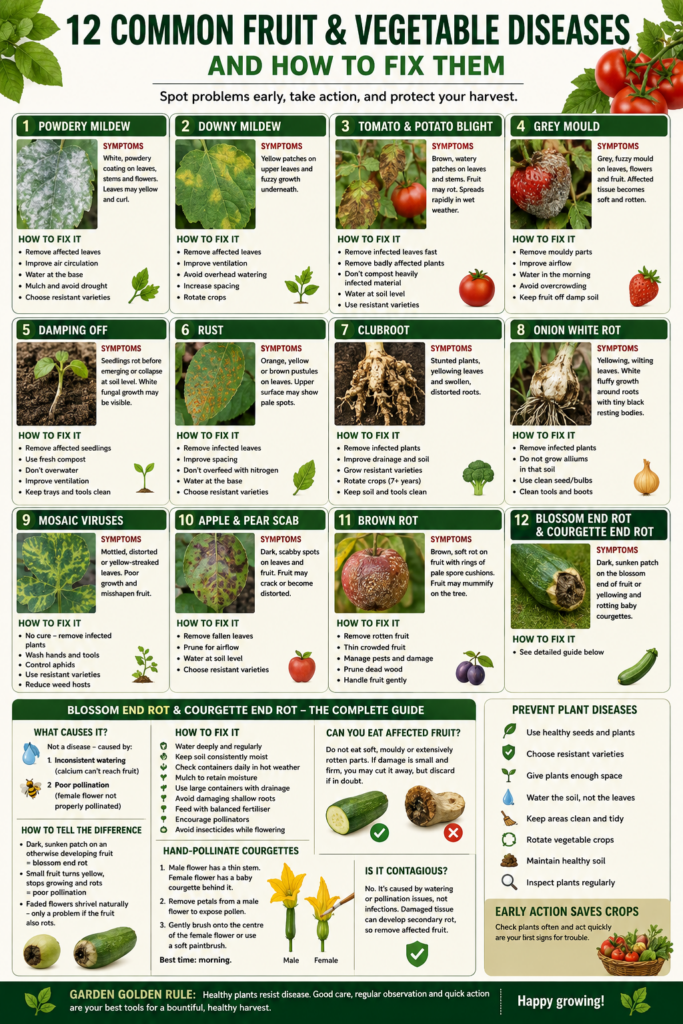
12 Common Fruit and Vegetable Diseases and How to Fix Them
Growing your own fruit and vegetables is incredibly rewarding, but even a well-maintained garden can develop plant diseases and growing disorders.
Brown leaves, white powder, rotten fruit and collapsing seedlings can appear suddenly. The good news is that early action can often limit the damage and protect the rest of your crop.
This guide explains how to identify and manage 12 common fruit and vegetable diseases. It also covers blossom end rot and courgette end rot, two growing problems that are frequently mistaken for infectious diseases.
How to Identify a Plant Disease
Before treating a struggling plant, inspect it carefully. Look at:
- Both sides of the leaves
- Stems and branches
- The base of the plant
- Roots, where practical
- Flowers and developing fruit
- Nearby plants of the same type
Pests, nutrient deficiencies, frost, drought, overwatering and poor pollination can produce symptoms that resemble disease. Identifying the pattern is often more useful than focusing on one damaged leaf.
Quick Plant Disease Diagnosis
| Symptom | Possible cause | Commonly affected plants |
|---|---|---|
| White powder on leaves | Powdery mildew | Courgettes, pumpkins, peas, apples and grapes |
| Yellow patches with mould underneath | Downy mildew | Brassicas, onions, lettuce and cucumbers |
| Rapidly spreading brown patches | Tomato or potato blight | Tomatoes and potatoes |
| Fluffy grey growth | Grey mould | Strawberries, tomatoes, grapes and lettuce |
| Seedlings collapsing at soil level | Damping off | Most young seedlings |
| Orange or brown leaf pustules | Rust | Leeks, beans, pears and other crops |
| Swollen, distorted roots | Clubroot | Cabbages, cauliflower and other brassicas |
| White growth around onion roots | Onion white rot | Onions, garlic, leeks and shallots |
| Mottled or distorted leaves | Mosaic virus | Tomatoes, cucumbers, courgettes and beans |
| Dark scabs on leaves and fruit | Apple or pear scab | Apples and pears |
| Soft brown fruit with pale rings | Brown rot | Apples, plums, pears and cherries |
| Sunken, dark or rotting patch at the flower end of the fruit | Blossom end rot, inconsistent watering or poor pollination | Courgettes, tomatoes, peppers and aubergines |
1. Powdery Mildew
Powdery mildew is one of the most recognisable vegetable plant diseases. It produces a white or grey powdery coating across leaves, stems and sometimes flowers.
Courgettes, cucumbers, pumpkins, peas, apples and grapevines are frequently affected. Infected leaves may turn yellow, curl or die prematurely.
What causes powdery mildew?
Unlike many fungal diseases, powdery mildew can become severe during warm, relatively dry weather.
Plants experiencing drought stress are particularly vulnerable, while crowded growth and poor air circulation help the disease spread.
How to treat powdery mildew
Remove the worst affected leaves, but avoid stripping the plant of all its foliage.
Water consistently at the base of the plant and apply organic mulch to help the soil retain moisture.
Thin overcrowded growth and provide enough space between plants. At the end of the season, clear badly affected foliage and choose resistant cultivars where available.
Do not confuse the natural silver markings found on some courgette and squash leaves with mildew. Natural markings are usually part of the leaf pattern and cannot be rubbed away.
2. Downy Mildew
Despite the similar name, downy mildew is not closely related to powdery mildew.
Typical symptoms include pale yellow or angular patches on the upper leaf surface and fuzzy white, grey or purple growth underneath.
Brassicas, lettuce, onions, peas, cucumbers and grapevines can all be affected.
Downy mildew is strongly associated with wet conditions and prolonged leaf wetness.
How to treat downy mildew
Remove affected leaves as soon as symptoms appear.
Improve ventilation around plants and avoid watering over the foliage, particularly late in the day.
Allow sufficient space between plants and control weeds that restrict airflow. Rotate susceptible vegetable families around the garden rather than planting them in the same bed every year.
Where downy mildew is a regular problem, select disease-resistant cultivars and avoid planting crops too densely.
3. Tomato and Potato Blight
Late blight is a destructive disease affecting tomatoes and potatoes. It is caused by the fungus-like organism Phytophthora infestans and can spread rapidly during warm, wet weather.
Early symptoms include watery or brown patches on leaves. Dark lesions may develop on stems, while tomato fruit can become brown and rotten.
Potato tubers may develop reddish-brown decay beneath the skin.
How to treat tomato and potato blight
Remove infected leaves immediately when only a small area is affected.
If the disease is spreading through the plant, remove the entire plant to reduce the production of spores.
Place heavily infected material in an appropriate council green-waste collection or dispose of it according to local guidance. Do not leave diseased foliage beside the growing area.
Water tomatoes and potatoes at soil level. Avoid wetting the leaves and provide good spacing.
Outdoor tomatoes may benefit from a clear rain shelter with open sides for ventilation.
Choose blight-resistant cultivars, inspect plants regularly during wet summer weather and remove volunteer potato plants left behind from previous crops.
4. Grey Mould
Grey mould, also known as botrytis, creates fuzzy grey-brown growth on leaves, stems, flowers and fruit.
Affected tissue often becomes soft, brown and rotten.
It is common on strawberries, raspberries, grapes, tomatoes, beans, cucumbers, courgettes and lettuce. It is particularly troublesome in humid, overcrowded greenhouses.
How to treat grey mould
Remove mouldy fruit and damaged plant material promptly.
Dead flowers should also be cleared because the fungus can use them to enter healthy tissue.
Increase ventilation in greenhouses and avoid overcrowding plants. Water in the morning so that accidental splashes have time to dry.
Keep ripening strawberries away from damp soil by using clean straw, strawberry mats or another suitable mulch.
Handle fruit carefully because botrytis can enter through small wounds.
5. Damping Off
Damping off attacks seedlings, particularly those grown indoors or under glass.
Seeds may rot before emerging, or seedlings may collapse where the stem meets the compost. White fungal growth sometimes appears around the affected plants.
Several soil-borne fungi and fungus-like organisms can cause damping off, including species of Pythium, Phytophthora, Rhizoctonia and Fusarium.
High humidity and wet growing media increase the risk.
How to stop damping off
Remove collapsed seedlings and any surrounding contaminated compost.
Healthy seedlings should be moved away from the affected area where possible.
For future sowings:
- Wash pots, trays and propagator lids before use.
- Use fresh seed compost.
- Sow seeds thinly.
- Avoid overwatering.
- Provide gentle ventilation after germination.
- Use clean water and equipment.
- Do not leave seed trays standing in water.
Once a seedling has collapsed, it will not recover. Prevention is therefore the most effective treatment.
6. Rust
Rust diseases produce yellow, orange, brown or black pustules, often on the undersides of leaves.
The corresponding upper surface may develop pale spots.
Rust can affect leeks, garlic, beans, pears and many other edible and ornamental plants.
Severe infections reduce the healthy leaf area and weaken the crop.
How to treat rust
Remove heavily infected leaves and clear fallen material from around the plant.
Improve spacing and avoid excessive nitrogen feeding, which can encourage soft, vulnerable growth.
Water at the base rather than over the foliage.
Where rust repeatedly affects the same crop, look for resistant cultivars and rotate annual vegetables to a different growing area.
Do not remove so many leaves that leeks, beans or fruit trees can no longer photosynthesise effectively. Concentrate on the worst affected material.
7. Clubroot
Clubroot affects vegetables in the brassica family, including cabbage, cauliflower, broccoli, Brussels sprouts, kale, swede and turnip.
Infected plants become stunted and may wilt during warm weather despite the soil being moist.
When lifted, their roots appear swollen, knobbly and distorted.
Can clubroot be cured?
There is no simple cure once soil is heavily contaminated.
Management focuses on reducing the disease and preventing it from spreading.
Remove infected plants carefully and avoid moving contaminated soil on boots, tools or plant roots.
Improve drainage because wet soil encourages infection.
Clubroot is generally less severe in alkaline soil. A soil test should be carried out before applying garden lime, as excessive liming can create nutrient problems and may increase the risk of common potato scab.
Other useful measures include:
- Growing resistant brassica cultivars
- Raising strong transplants before planting out
- Using containers or clean raised beds
- Following a long crop rotation
- Removing brassica weeds such as shepherd’s purse
8. Onion White Rot
Onion white rot affects onions, garlic, shallots and leeks.
Leaves turn yellow and wilt, usually starting with the oldest growth.
White fluffy fungal growth may appear around the roots and base of the bulb, together with tiny black resting bodies.
The disease can remain in contaminated soil for many years.
How to manage onion white rot
Lift infected plants carefully and remove as much affected root material as possible.
Do not transfer soil from the affected area to other beds.
Stop growing onions, garlic, leeks and shallots in the contaminated ground. Where space is limited, grow alliums in large containers filled with clean growing media.
Clean tools, boots and equipment after working in the affected bed.
Purchase healthy planting material from a reputable supplier and avoid adding questionable onion waste to the growing area.
9. Mosaic Viruses
Mosaic viruses can cause mottled light and dark areas on leaves, distorted growth, yellow streaks and reduced yields.
Fruit may also become marked or misshapen.
Tomatoes, cucumbers, courgettes, beans, peppers and several other crops can be affected.
Multiple viruses can produce similar symptoms, which means visual identification is not always conclusive.
How to treat a plant virus
There is no treatment that will remove a virus from an infected plant.
Remove severely affected plants, especially when symptoms are spreading or neighbouring plants remain healthy.
Wash your hands and clean cutting tools before handling other crops.
Reduce weeds that may act as virus hosts and manage sap-feeding pests such as aphids, which can transmit certain viruses.
Use healthy seed and planting material, and choose resistant cultivars where available.
Avoid saving seed from plants showing unexplained mosaic patterns or severe distortion.
10. Apple and Pear Scab
Apple and pear scab produces dark olive, brown or black marks on leaves and fruit.
Infected fruit may become cracked, distorted or unsuitable for storage, although lightly marked fruit can still develop.
The fungi spread through airborne and rain-splashed spores. They can overwinter on fallen leaves and infected shoots.
How to control apple and pear scab
Collect fallen leaves and remove badly infected fruit.
Prune overcrowded branches during the appropriate season to improve airflow through the tree.
When watering young trees, direct water towards the soil rather than the canopy.
Avoid planting susceptible trees in very enclosed, damp positions.
For long-term control, choose cultivars with good scab resistance. This is particularly useful in gardens where the disease appears every year.
11. Brown Rot
Brown rot affects apples, pears, plums, cherries, peaches, nectarines and apricots.
A small brown patch develops on the fruit and spreads quickly.
Pale brown or buff-coloured spore cushions may appear in rings. Rotten fruit may fall or remain on the tree as hard, shrivelled mummies.
Infection frequently begins through damage caused by birds, insects, cracking or another disease. It can also spread between fruit that are touching.
How to treat brown rot
Remove rotten fruit as soon as it is noticed.
Check the tree again after leaf fall and remove any mummified fruit still attached to the branches.
Thin crowded fruit clusters so that developing fruit do not press against each other.
Manage insect and bird damage where practical, and remove dead blossom spurs or infected shoots during suitable pruning weather.
Handle harvested fruit gently and store only sound, undamaged produce.
12. Blossom End Rot and Courgette End Rot
Blossom end rot is a common growing disorder affecting tomatoes, peppers, aubergines and courgettes.
It is not an infectious disease and cannot spread between plants.
On tomatoes, peppers and aubergines, the first symptom is usually a watery patch at the blossom end of the fruit. This gradually becomes brown or black, sunken and leathery.
Courgette end rot can look slightly different. A young courgette may stop growing, turn yellow or brown at the flower end and begin to rot. The affected fruit may then become soft and drop from the plant.
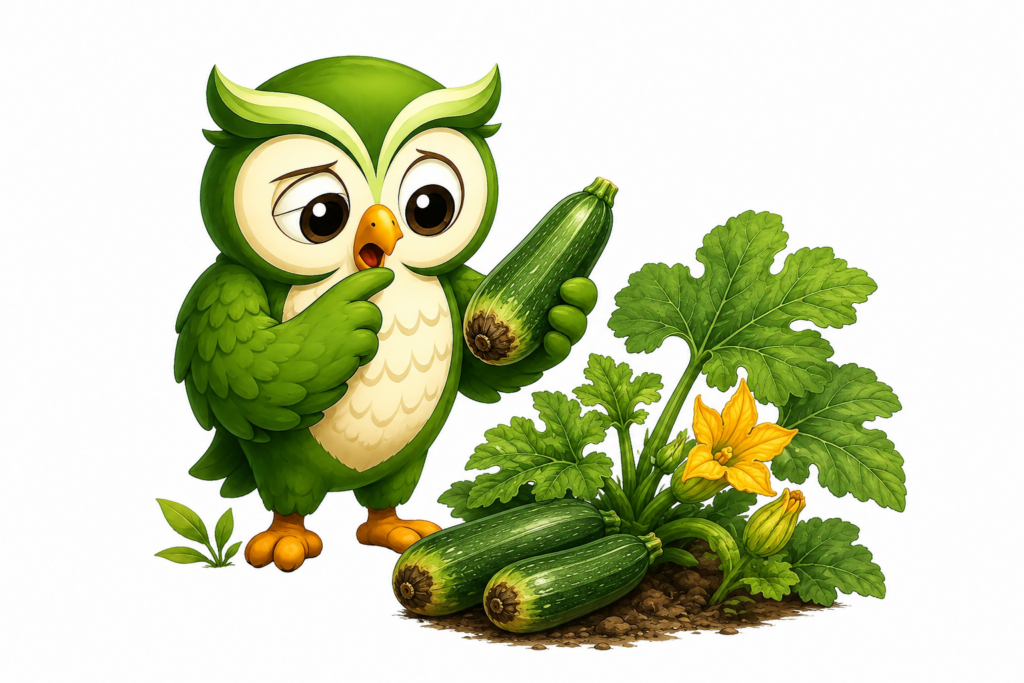
What causes courgette end rot?
There are two common causes of rotting at the end of a courgette.
Inconsistent watering
Blossom end rot develops when insufficient calcium reaches the growing fruit.
Most garden soils contain enough calcium, but the plant cannot absorb and transport it effectively when soil moisture repeatedly changes from very dry to very wet.
Courgettes are thirsty plants with large leaves, so those grown in containers or exposed to hot weather are particularly vulnerable to irregular watering.
Poor pollination
Young courgettes can also rot when the female flower has not been properly pollinated.
The fruit may begin to swell but then stop developing, turn yellow and rot from the flower end.
Poor pollination is more common during cold or wet weather, when fewer pollinating insects are active.
It can also occur when a plant produces female flowers before enough male flowers have opened.
How to tell the difference
A dark, sunken or leathery patch on an otherwise developing fruit is more likely to be blossom end rot.
A very small courgette that turns yellow, becomes soft and stops growing is more likely to have been poorly pollinated.
Faded courgette flowers naturally shrivel after flowering. This is not a problem unless the attached fruit also becomes soft, discoloured or rotten.
How to fix courgette end rot
Affected courgettes will not recover, so remove them with a clean knife or pair of secateurs.
This allows the plant to direct its energy towards healthy developing fruit.
To reduce further problems:
- Water courgette plants deeply and regularly.
- Keep the soil consistently moist without leaving it waterlogged.
- Check container-grown courgettes every day during hot weather.
- Apply organic mulch around plants to reduce moisture loss.
- Use a large container with adequate drainage.
- Avoid damaging the shallow roots when hoeing or cultivating.
- Feed with a balanced fertiliser rather than applying excessive nitrogen.
- Encourage bees and other pollinators by growing nectar-rich flowers nearby.
- Avoid using insecticides while courgettes are flowering.
Calcium supplements are rarely necessary unless a soil test confirms a deficiency.
Correcting irregular watering is usually more effective.
How to hand-pollinate courgettes
When pollinating insects are scarce, courgette flowers can be pollinated by hand.
Identify a male flower by its thin, straight stem. Female flowers have a small immature courgette directly behind the flower.
Pick an open male flower and remove its petals to expose the pollen-covered centre.
Gently brush it against the centre of an open female flower. Alternatively, transfer the pollen using a small, soft paintbrush.
Hand-pollination is best carried out in the morning, when the flowers are fully open and the pollen is fresh.
Can you eat a courgette affected by end rot?
Do not eat sections that are soft, mouldy, unpleasant-smelling or extensively rotten.
A courgette with a small, firm area of superficial damage may sometimes be usable after the affected part has been removed, but damaged fruit should be discarded whenever there is any doubt.
Is courgette end rot contagious?
No. End rot caused by inconsistent watering or poor pollination is not contagious.
However, damaged tissue can develop secondary fungal or bacterial decay, so affected fruit should be removed promptly.
How to Prevent Fruit and Vegetable Diseases
Many garden diseases are easier to prevent than cure. A simple routine can greatly reduce the risk.
Choose healthy plants and seeds
Buy seeds, bulbs, tubers and young plants from reputable sources.
Inspect plants before introducing them to a greenhouse or vegetable plot.
Grow resistant cultivars
Disease resistance does not always mean complete immunity, but it can reduce the severity of recurring problems such as blight, scab, clubroot and mildew.
Give plants enough space
Overcrowded plants dry slowly after rain and create humid conditions around the leaves.
Follow the recommended spacing for each crop and prune fruit trees to maintain an open structure.
Water the soil, not the leaves
Use a watering can, drip system or soaker hose to direct water towards the roots.
Morning watering is usually preferable because wet surfaces can dry during the day.
Keep growing areas clean
Remove rotten fruit, dead leaves and badly diseased growth.
Clean pots, trays, stakes and cutting tools before reusing them.
Not every diseased leaf needs to be treated in the same way. Some common foliar diseases break down during composting, while persistent soil-borne diseases require more cautious disposal.
Follow disease-specific and local green-waste guidance.
Rotate vegetable crops
Avoid growing the same plant family in the same bed every season.
Rotation is particularly useful for reducing the build-up of soil-borne problems, although it cannot eliminate every disease.
Maintain healthy soil
Improve compacted or poorly drained ground with suitable organic matter.
Feed plants according to their needs rather than applying excessive fertiliser.
Healthy plants are generally better able to tolerate minor infections and environmental stress.
Should You Use a Fungicide?
Non-chemical methods should usually be the first option in a home fruit and vegetable garden.
Good hygiene, ventilation, watering and resistant cultivars often provide the most sustainable control.
Where a plant-protection product is considered, check that it is currently authorised for the exact crop and problem.
Follow the label instructions, harvest interval and safety precautions.
Never assume that a treatment suitable for ornamental plants can be applied to edible crops.
Frequently Asked Questions
What is the most common vegetable plant disease?
There is no single disease that affects every garden.
Powdery mildew, grey mould, damping off and blight are among the most frequently encountered problems, but local weather and the crops being grown make a major difference.
Can a diseased plant recover?
Plants with a mild fungal infection may continue growing after affected material is removed and conditions are improved.
Plants with severe blight, extensive root disease or a virus are less likely to recover and may need to be removed.
Should I remove every damaged leaf?
No.
Remove leaves that are heavily infected or actively producing mould, but retain enough healthy foliage for the plant to grow.
Removing too many leaves can weaken the plant and expose fruit to sun damage.
Does crop rotation stop all vegetable diseases?
No.
Rotation is useful for many soil-borne problems, but diseases can also arrive through airborne spores, infected plants, contaminated tools or insect vectors.
It should form part of a wider prevention plan.
Why do my plants keep developing fungal diseases?
Repeated fungal problems are often linked to poor airflow, prolonged leaf wetness, overcrowding, contaminated plant debris or susceptible cultivars.
Review the growing conditions as well as treating the visible symptoms.
Is blossom end rot contagious?
No.
Blossom end rot is caused by a disruption in calcium movement into developing fruit, usually associated with inconsistent watering.
It cannot spread from one plant to another.
Why are my baby courgettes turning yellow and rotting?
Small courgettes often turn yellow and rot because the female flower was not properly pollinated.
Cold or wet weather, low pollinator activity and a shortage of open male flowers can all contribute.
Remove the affected fruit and hand-pollinate newly opened flowers if necessary.
Should I add calcium to treat courgette end rot?
Usually not.
Most soils already contain sufficient calcium. The more common problem is irregular watering, which prevents the plant from moving calcium into the developing fruit.
Keep the soil evenly moist and avoid allowing container-grown plants to dry out completely.
Final Thoughts
Finding diseased fruit or vegetables can be disappointing, but one affected leaf or fruit does not always mean the entire crop is lost.
Identify the symptoms, remove badly affected material and correct any problems with watering, pollination, spacing, hygiene or ventilation.
For recurring diseases, resistant cultivars and better crop rotation can make a significant difference.
The most effective approach is to inspect plants regularly. Catching blight, mould, rot, mildew or courgette end rot early gives you the best chance of limiting the damage and enjoying a healthy harvest.